
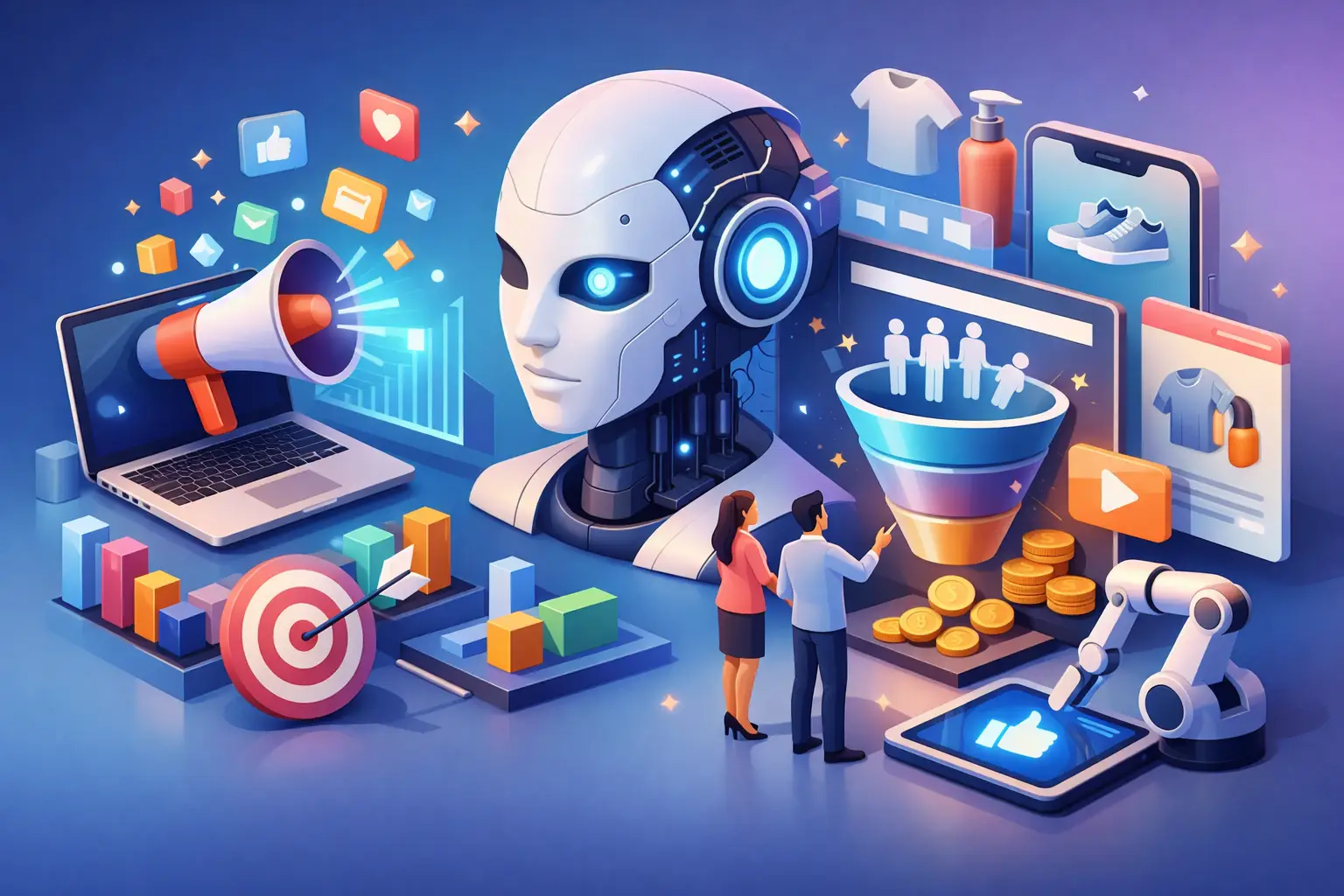
A lot of businesses are told to use AI like it is a magic button. It is not. The real value shows up when you look at practical ai in advertising examples that reduce wasted spend, speed up production, and help campaigns perform better without adding more internal chaos.
For growing brands, that matters. You do not need another shiny tool. You need better ads, faster decisions, and creative that can scale across search, social, video, email, and even in-store promotion. That is where AI starts earning its keep.
Why ai in advertising examples matter to real businesses
Most small and mid-sized companies are not asking whether AI is interesting. They are asking whether it helps generate leads, improve return on ad spend, and take pressure off already stretched teams. That is the right question.
The best AI use cases in advertising are not the most futuristic ones. They are the ones that remove bottlenecks. Think faster copy testing, smarter audience modeling, automated bid adjustments, and creative resizing that does not eat up a designer’s day. Used well, AI supports execution. Used poorly, it creates generic campaigns that look cheap and underperform.
That trade-off matters. AI can increase speed, but speed without strategy is just faster waste.
11 ai in advertising examples brands can use now
1. Predictive audience targeting
One of the strongest examples is using AI to identify which audience segments are most likely to convert. Instead of relying only on broad assumptions like age or location, AI can analyze behavior patterns, purchase history, website activity, and engagement signals to find higher-intent prospects.
This works especially well for service businesses and ecommerce brands with enough campaign data to train the platform. The catch is simple. If your data is messy or too limited, the targeting can drift. AI is only as useful as the signals it receives.
2. Smart bidding in paid search
Google Ads has made this mainstream. AI-driven bidding adjusts bids based on real-time signals like device, time of day, search intent, and conversion probability. For businesses running lead generation campaigns, this can improve efficiency quickly.
But automation is not a free pass. Smart bidding performs better when conversion tracking is accurate and campaign goals are clear. If the account is feeding bad data into the system, the algorithm will optimize for the wrong outcome with total confidence.
3. Dynamic ad creative for different users
AI can assemble different combinations of headlines, descriptions, images, and calls to action based on who is seeing the ad. That means one campaign can serve slightly different messaging to different audience groups without manually building every variation.
This is one of the most practical ways to scale advertising output. A local home service brand, for example, might show trust-focused messaging to cold audiences and urgency-focused messaging to returning visitors. Same offer, different angle. Better fit.
4. AI-generated copy variations
Ad copy testing used to take time most teams did not have. Now AI can generate multiple versions of headlines, primary text, and value propositions in minutes. That gives marketers more angles to test, especially when campaigns need to move fast.
Still, quantity is not the same as quality. Generic AI copy often sounds polished but forgettable. The better approach is to use AI for first drafts and variation building, then have a strategist or copywriter sharpen the offer, tone, and positioning.
5. Product recommendations in retargeting ads
If a user viewed certain products or categories, AI can help decide which items to feature next in retargeting campaigns. This is common in ecommerce, but the same logic can apply to service packages, event promotions, or location-based offers.
Done right, it feels relevant. Done badly, it feels intrusive or repetitive. Frequency control and creative variety still matter. AI helps decide what to show, but human oversight helps decide when enough is enough.
6. Creative resizing and adaptation across channels
A campaign rarely lives in one place. It may need square social ads, vertical story formats, display banners, YouTube pre-roll visuals, and signage mockups for offline promotion. AI tools can speed up resizing, background extension, subtitle generation, and asset adaptation across formats.
This is where operational gains are real. Teams save hours, sometimes days. But there is a limit. High-impact brand campaigns still need design judgment. Not every layout should be automated, especially when the brand presentation has to feel premium.
7. AI-powered video ad editing
Short-form video is now a core ad format, and AI is helping brands move faster with clip selection, auto-captioning, scene detection, voice cleanup, and multiple edit versions for different audiences. For fast-moving campaigns, this can cut production time dramatically.
The strongest use case is not replacing creative direction. It is accelerating execution after the concept is already clear. If the underlying footage is weak or the message is unfocused, AI editing will not save the campaign.
8. Chat-driven lead qualification from ads
Some brands now send ad traffic into AI-assisted chat experiences instead of static landing pages alone. That can work well for appointment-based services, quote requests, and businesses with high inquiry volume. The AI can answer basic questions, collect lead details, and route prospects faster.
This is especially useful when response time affects conversion rates. The risk is obvious. If the chatbot gives vague answers or cannot handle real objections, leads drop off fast. The script and workflow need to be built around real customer behavior, not just automation for its own sake.
9. Sentiment analysis for campaign optimization
AI can scan comments, reviews, responses, and engagement patterns to identify how audiences are reacting to a campaign. That helps brands catch messaging problems early and understand which themes are creating stronger emotional response.
For reputation-sensitive industries, this is valuable. A campaign might be getting clicks but generating the wrong type of attention. AI helps spot that faster. Human judgment is still needed to interpret context, sarcasm, and cultural nuance.
10. Lookalike modeling from high-value customers
Another strong example is using AI to find new users who resemble a brand’s best existing customers, not just any customer. That distinction matters. Optimizing toward high-value buyers, repeat clients, or strong lead quality can outperform campaigns optimized only for cheap clicks.
This approach can be powerful for businesses with a clear customer profile. If your business model serves several very different audiences, though, one lookalike model may blur together segments that should stay separate.
11. Forecasting creative fatigue before performance drops
One of the less talked-about ai in advertising examples is fatigue prediction. AI can identify patterns that suggest an ad is losing impact before results collapse completely. That gives teams time to rotate messaging, refresh visuals, or test new formats earlier.
This matters because many campaigns are not failing from bad targeting alone. They are failing because the same creative has been pushed too long. AI can flag the trend, but the replacement still needs strong creative thinking.
Where AI works best in advertising
AI works best in systems with volume, repeatable patterns, and measurable outcomes. Paid search, ecommerce retargeting, social ad testing, lead qualification, and content versioning are all strong candidates because they generate enough signals to optimize against.
It is less reliable when the business lacks clean data, the offer is weak, or the campaign depends heavily on subtle brand storytelling. A luxury launch, a high-stakes rebrand, or a niche B2B service with a long sales cycle may need more human control. That does not mean AI has no role. It just means the role shifts from decision-maker to support engine.
For many businesses, the sweet spot is hybrid execution. Use AI for speed, pattern recognition, and production efficiency. Use experienced marketers and creatives for positioning, quality control, and campaign direction. That is where better performance usually comes from.
What smart brands get right about AI in advertising
The strongest advertisers are not asking AI to do everything. They are using it where it creates leverage. That means clearer briefs, stronger tracking, better creative inputs, and tighter review processes. AI amplifies the system already in place.
This is why businesses often get mixed results. One company uses AI to multiply a solid ad strategy and wins. Another uses it to mass-produce weak messaging and burns budget faster. Same technology, very different outcome.
If you are building campaigns across Google, Meta, websites, landing pages, content, and even physical brand touchpoints, integration matters more than hype. A modern creative partner like Goonj88 can use AI to increase speed and output, but the point is still the same as it has always been: stronger advertising that moves the business forward.
The most useful question is not whether AI belongs in your advertising. It is where it can save time, sharpen decisions, and improve performance without flattening your brand into something forgettable.