
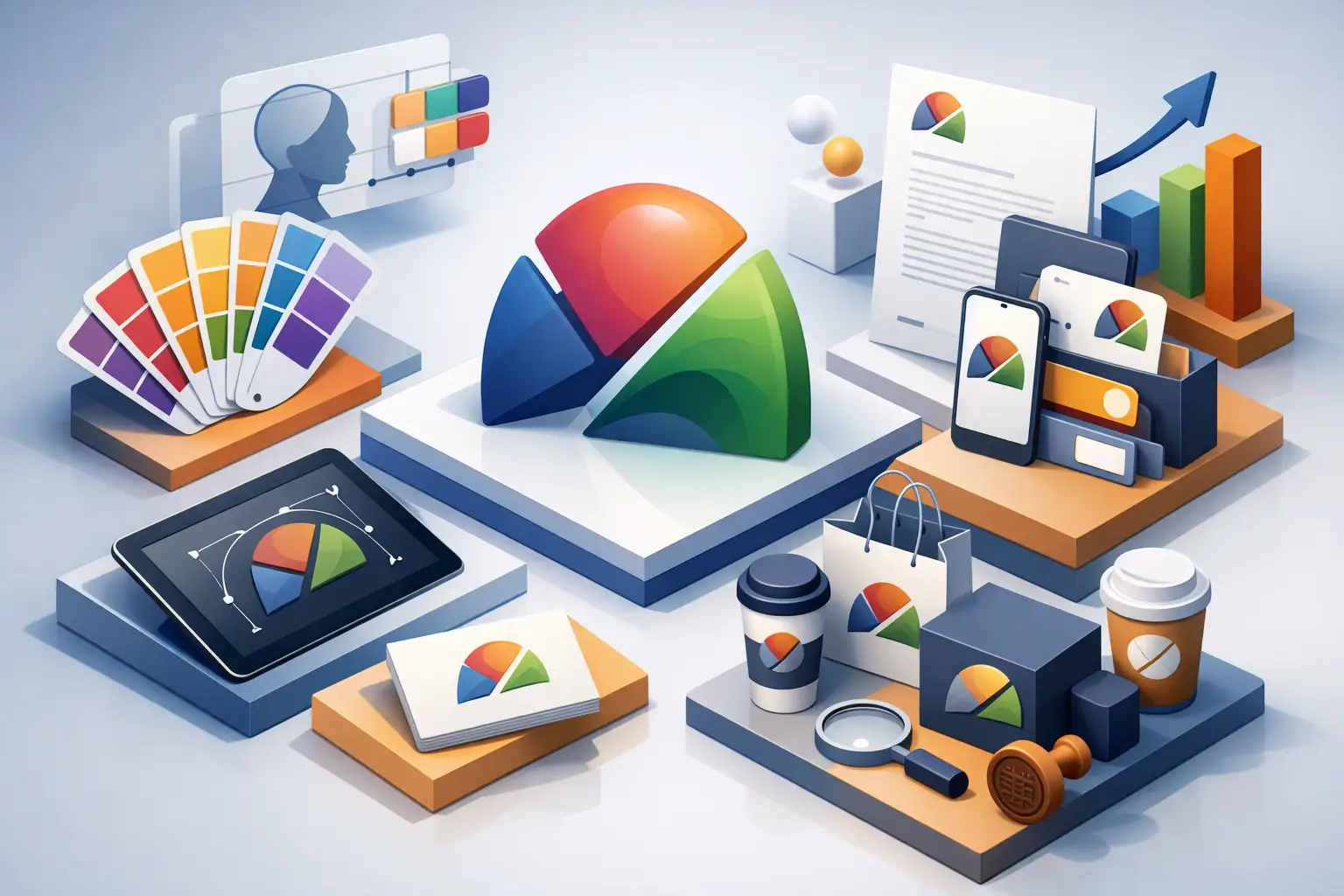
A business can spend thousands on ads, build a polished website, and still feel forgettable the moment a customer sees its Instagram page, storefront sign, sales deck, or packaging. That gap is exactly where brand identity design services matter. They turn scattered visuals into a system people recognize, trust, and remember.
For growing businesses, this is not a cosmetic upgrade. It affects how credible you look, how consistently your team presents the brand, and how efficiently you roll out marketing across every channel. If your business is scaling, launching, rebranding, or simply trying to stop looking pieced together, brand identity work becomes a growth decision, not just a design decision.
What brand identity design services actually include
A lot of businesses think branding starts and ends with a logo. A logo matters, but on its own, it cannot carry your whole market presence. Real brand identity design services build the visual and strategic framework around that logo so the brand performs consistently wherever customers meet it.
That usually includes logo systems, typography, color palette, icon style, image direction, layout rules, social media design language, presentation templates, packaging direction, and brand guidelines. In many cases, it should also cover how the identity appears on websites, paid ads, signage, trade show displays, uniforms, vehicle wraps, and printed collateral.
The difference is simple. A logo is an asset. A brand identity is an operating system.
That operating system helps your business move faster. Instead of reinventing every flyer, landing page, booth backdrop, or campaign graphic, your team works from a defined visual structure. The result is better output with less confusion.
Why businesses outgrow DIY branding fast
Early-stage companies often piece things together out of necessity. One freelancer designs the logo. Another person builds the website. Social media graphics get made by whoever is available. A printer adjusts the colors for signage. Months later, the brand looks different in five different places.
That may be manageable when you are small. It becomes expensive when growth starts to depend on trust, speed, and repetition.
Customers notice inconsistency faster than most business owners expect. If your website feels premium but your storefront sign looks dated, or your ad creative looks modern but your sales materials look generic, the brand starts sending mixed signals. Mixed signals weaken confidence. That costs attention, leads, and conversions.
This is why serious brand identity design services are often most valuable for small to mid-sized businesses that are entering a more competitive stage. At that point, design needs to support performance. It has to work across digital and physical touchpoints, not just look attractive in a portfolio file.
Brand identity design services should support growth, not just aesthetics
Good design absolutely needs taste. But for a business investing in growth, taste is only part of the job.
The stronger question is whether the identity helps the company sell, scale, and stay consistent under pressure. Can it stretch across ad creatives, web pages, social posts, event materials, printed menus, packaging, fleet graphics, and signage without breaking apart? Can new team members or outside vendors use it without guessing? Can it hold up across local marketing and broader digital campaigns?
That is where weaker branding packages often fall short. They deliver a few logo files, maybe a palette and fonts, then leave the business to figure out the rest. It feels complete at handoff, but incomplete in practice.
An effective identity system is built for real usage. It anticipates motion graphics, responsive web design, paid media formats, sales presentations, in-store visuals, and production needs. It also accounts for the fact that businesses evolve. A good system gives structure without making future growth harder.
What to look for in a brand identity design partner
Not every design provider approaches branding the same way. Some are highly conceptual and create strong visuals but do not think deeply about rollout. Others are practical and fast but deliver identities with no distinct edge. The right fit depends on the stage of your business, your timeline, and how many channels the brand needs to support.
If your company needs active marketing, website execution, ad creative, and physical branding all moving together, it helps to work with a partner who understands the full ecosystem. Brand identity should not live in isolation from performance marketing or production reality.
Look for a team that asks how the brand will be used, not just what style you prefer. They should want to know where leads come from, what your sales process looks like, who your audience is, how your physical presence matters, and what your next 12 months of growth require. Those questions lead to better creative decisions.
You should also pay attention to process. Strong brand identity design services usually include discovery, strategic direction, concept development, refinement, application design, and documentation. If there is no clear process, there is a higher chance you get subjective design rounds with no real business logic behind them.
Speed matters too, but speed without systems creates rework. The best partners move fast because they know how to align strategy, design, and production from the beginning.
The real business value of consistent identity
Consistency sounds like a branding cliché until you measure how much time and money inconsistency wastes.
When a brand identity is well built, your campaigns launch faster. Designers do not have to guess. Sales teams do not create off-brand materials. Printers and fabricators are less likely to make production errors. Social content becomes easier to scale. Web pages feel connected to ad creative. Signage reinforces the same impression customers got online.
That consistency compounds. People recognize the brand more quickly. The business looks more established. Marketing starts feeling more intentional. Even if a prospect does not consciously analyze every touchpoint, they feel the difference.
For local businesses, this is especially important. A customer might discover you through Google, visit your website, see your Instagram page, then drive past your location. If each point tells the same visual story, credibility rises. If each point feels disconnected, trust drops.
Where brand identity design services often fail
The biggest failure is designing for presentation instead of implementation. A polished mockup is easy to love. A usable identity system is harder to build.
Another common issue is underestimating physical applications. Brands that look strong on a desktop screen do not always translate well to storefronts, event booths, large-format print, or vehicle graphics. Typography, spacing, color contrast, and logo flexibility all behave differently in the real world.
There is also the issue of overdesign. Some identity systems are so trend-driven or visually complicated that they become hard to use at speed. That might work for a niche fashion label. It is less effective for a service business running ads, updating a website, printing sales material, and producing local signage on tight timelines.
The sweet spot is distinct but usable. Memorable but not fragile. Modern without becoming dated six months later.
Why integrated execution gives branding more power
A brand identity becomes more valuable when the same team, or a tightly aligned partner, can help apply it across marketing and production. That closes the gap between strategy and output.
For example, an identity designed with web structure, ad creative, motion assets, and signage in mind will usually perform better than one created in a vacuum. It is more likely to stay consistent because the people building campaigns and physical materials understand the system from the start.
This is where a hybrid agency model has a real advantage. Instead of splitting branding, web, marketing, and production across multiple vendors, businesses can move with more control and less friction. For companies that need momentum, that matters. Goonj88 works well in this space because the brand identity conversation does not stop at files and guidelines. It extends into how the brand actually shows up, competes, and grows.
Brand identity design services are not one-size-fits-all
A startup launching its first brand needs something different from an established company preparing for expansion. A restaurant brand has different identity demands than a home service business or a B2B firm. Some companies need a full strategic reset. Others need a visual cleanup and stronger brand rules around an already recognizable identity.
Budget also changes the scope. Not every business needs a massive rebrand. But almost every growing business benefits from stronger visual alignment and a clearer brand system. The key is building the right level of identity for where the business is now, while making sure it can support where the business wants to go next.
That is the practical lens to use. Not, “Do we need branding?” but, “What kind of identity system will help us grow without creating more complexity?”
The strongest brands are not always the loudest. They are the ones that show up clearly, consistently, and confidently wherever the customer looks. If your business is ready to be taken more seriously, your brand should be ready to do the same work your marketing does every day.