
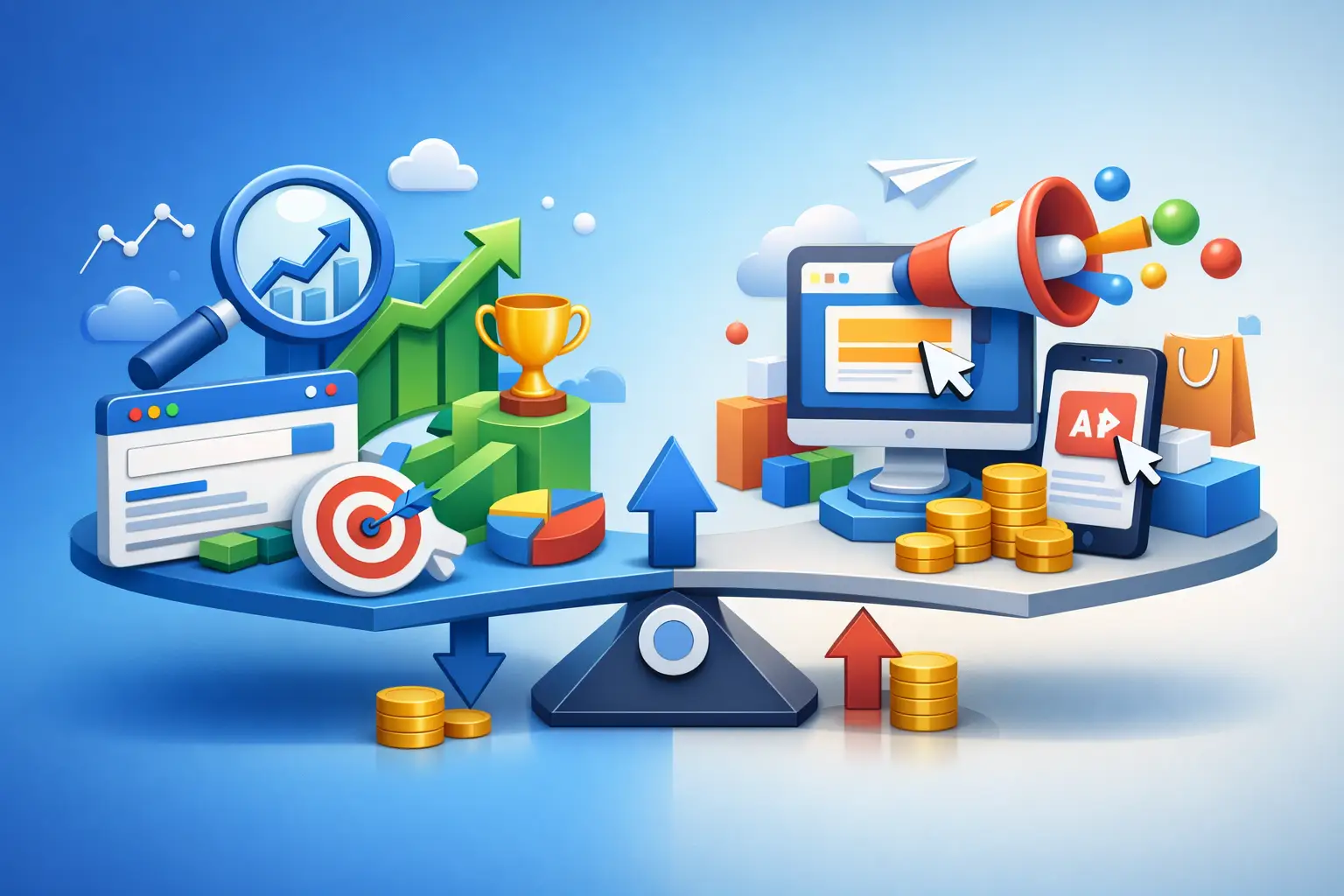
A lot of businesses ask the wrong question about seo vs google ads. They ask, “Which one is better?” The smarter question is, “Which one moves my business forward fastest without wasting budget?” If you need leads now, Google Ads can put you in front of buyers this week. If you want compounding visibility that keeps working after the monthly spend is gone, SEO earns that position over time.
That difference matters more than most businesses realize. Owners and marketing managers are often not choosing between two marketing tactics. They are choosing between short-term pipeline pressure and long-term brand growth. Get that balance wrong, and you either burn cash chasing instant traffic or wait too long for results while competitors take the calls.
SEO vs Google Ads: The real difference
SEO is the work of earning visibility in organic search results. That includes technical site health, local optimization, content strategy, on-page improvements, authority building, and user experience. It takes time, but it builds an asset. When your pages rank well, they can continue bringing in traffic and leads without paying for every click.
Google Ads is paid placement inside Google search and other Google properties. You bid on keywords, build campaigns, write ad copy, shape landing pages, and pay when someone clicks. It is fast, measurable, and powerful when the campaigns are structured correctly. It can also get expensive fast when targeting, copy, or landing pages are weak.
The biggest difference is not organic versus paid. It is momentum versus immediacy. SEO builds momentum. Google Ads buys immediacy.
When SEO makes more sense
SEO is usually the stronger play when your business needs durable visibility, not just a short burst of traffic. If you are a local service provider, a multi-location brand, a medical office, a law firm, a contractor, or an established company trying to dominate key searches in your market, SEO deserves serious investment.
Why? Because search intent compounds. If people search for your service every month, and your business consistently appears in local results and organic rankings, your lead flow becomes less dependent on ad spend. That creates leverage. You are no longer renting every visitor.
SEO also works well when trust matters. Many users still skip ads and go straight to organic listings because they perceive them as more credible. For service businesses with longer sales cycles or higher-ticket offers, that trust can affect conversion quality.
There is a trade-off, though. SEO is slower. Even strong execution usually takes months, not days. In competitive markets, progress can be steady without looking dramatic at first. If your business needs leads by next week, SEO alone will feel painfully slow.
SEO is strongest when:
Your website already has some authority, your market has ongoing search demand, and your business can wait for compounding returns. It is also a better fit when your brand wants broader market presence, not just leads from one campaign.
When Google Ads makes more sense
Google Ads is the faster answer when timing matters. If you just launched, entered a new market, added a new service, or need immediate lead volume, paid search can create traction quickly. It is especially effective for high-intent searches where people are actively looking for a solution right now.
That speed is why Google Ads is often the first serious acquisition channel for growing businesses. You can launch campaigns, test offers, adjust messaging, and start learning almost immediately. Done right, it gives you data fast – which keywords convert, which locations perform, what messaging gets clicks, and which landing pages close.
It also gives you control. You can focus spend by geography, schedule, device, service line, or audience behavior. SEO does not give that kind of precision.
But speed comes with pressure. Every click costs money. If your cost per lead rises, your landing page underperforms, or your follow-up process is weak, the campaign can become expensive without creating profit. Google Ads is not magic. It is a system, and weak systems leak budget.
Google Ads is strongest when:
You need immediate visibility, want to validate demand quickly, or have a proven sales process that can turn paid traffic into revenue. It also works well for seasonal offers, event-driven promotions, and highly specific service campaigns.
SEO vs Google Ads on cost
This is where many businesses get trapped by surface-level thinking. SEO feels cheaper because you are not paying per click. Google Ads feels expensive because every visit has a visible price tag. But the better question is cost per qualified lead and cost per acquired customer over time.
SEO usually requires upfront investment in strategy, content, technical fixes, local optimization, and ongoing improvement. It may not produce strong returns immediately, but once rankings improve, your marginal cost per click effectively drops. That is why SEO can become one of the most efficient channels over the long run.
Google Ads gives you predictable spend, but not predictable efficiency. In competitive industries, click costs can rise quickly. If your campaigns are managed poorly, you pay premium prices for low-intent traffic. If managed well, the channel can produce profitable lead flow at scale.
So which is cheaper? It depends on your timeline. SEO is often more cost-efficient over 12 months and beyond. Google Ads is often more effective in the first 30 to 90 days.
Which channel converts better?
There is no universal winner. Conversion depends on intent, trust, offer strength, and page experience.
Google Ads often converts well when someone has immediate buying intent. Searches like “emergency plumber near me” or “same day sign printing” usually favor paid results because urgency is high and users act fast. In those cases, showing up instantly matters.
SEO often performs better when buyers are researching, comparing, or looking for a provider they can trust. Organic visibility across multiple pages can support that journey better than a single paid ad. If someone visits your service pages, reads useful content, checks reviews, and sees strong local signals, SEO can produce high-quality inquiries.
The hidden factor is your website. A weak site can ruin both channels. If your page loads slowly, feels outdated, has weak calls to action, or does not answer the visitor’s questions fast enough, traffic will not convert whether it came from SEO or Google Ads.
The smartest play is usually both
For most small and mid-sized businesses, seo vs google ads is not an either-or decision forever. It is a sequencing decision.
Google Ads helps you capture demand now. SEO helps you reduce dependence on paid media later. Run together, they create a stronger growth engine. Paid campaigns drive immediate traffic and reveal keyword data. SEO builds the long-term foundation that keeps your brand visible, trusted, and harder to displace.
This is where an integrated approach wins. If your ad team learns which search terms convert, your SEO strategy can prioritize those themes. If your SEO content reveals high-engagement topics, your ads can reflect that language. The channels should inform each other, not compete for attention internally.
For local businesses, this combined approach is even stronger. Google Ads can target urgent service searches while SEO, local content, and Google Business Profile optimization build long-term local authority. That gives you both short-term lead flow and a stronger organic footprint.
How to decide what to prioritize first
If your business needs leads quickly, start with Google Ads and build SEO in parallel. If your business already has some lead flow and wants lower acquisition costs over time, increase SEO investment while using paid search more selectively.
If your website is weak, fix that before scaling either channel. Traffic without conversion is just expensive noise. If your market is highly competitive, expect both SEO and Google Ads to require sharper strategy, better creative, and tighter execution.
A practical way to think about it is simple. Use Google Ads to buy speed. Use SEO to build staying power. The right mix depends on your cash flow, your urgency, your sales process, and how aggressively you want to grow.
At Goonj88, that is how we look at performance marketing in the real world. Not as isolated tactics, but as connected growth systems built around visibility, conversion, and scale.
If you are still deciding between the two, stop looking for a universal winner. Look at your timeline, your margins, your market, and your capacity to follow up on leads. The businesses that grow fastest are rarely the ones asking which channel is best in theory. They are the ones building the right engine for what the business needs right now.