
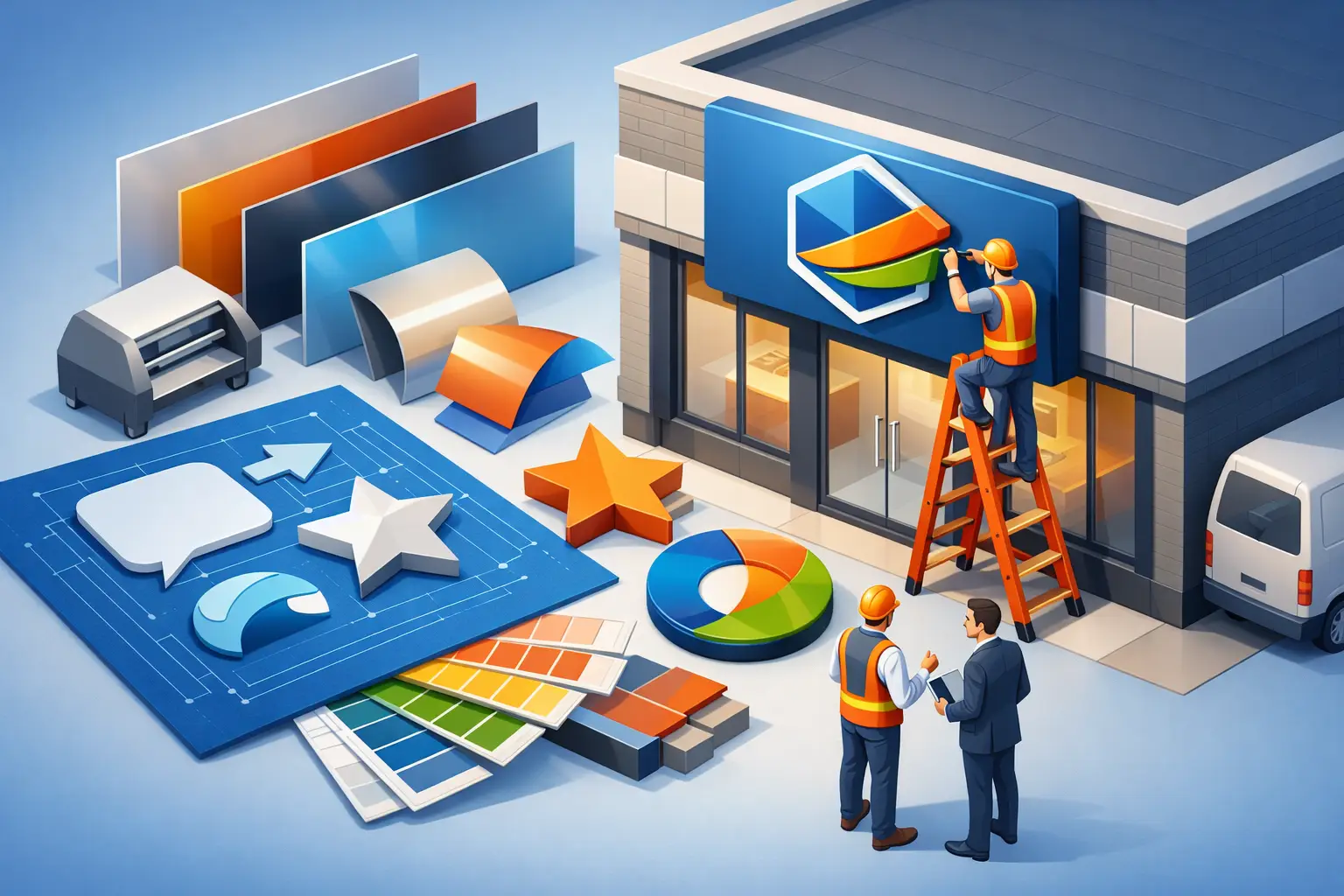
A bad sign does more damage than most businesses realize. It can make a strong brand look inconsistent, a busy storefront look forgettable, and a promising location feel harder to trust. Choosing the right custom business signage company is not just about getting a logo printed on a board. It is about making sure your brand shows up clearly, professionally, and at the standard your customers expect before they ever walk through the door.
For growing businesses, signage is not a side task. It is part of sales, part of brand perception, and part of operations. Storefront signs, indoor displays, event backdrops, window graphics, wayfinding, trade show materials, and promotional boards all influence how people experience your business in real life. If your digital marketing is sharp but your physical presence feels rushed, customers notice the gap.
What a custom business signage company actually does
A strong custom business signage company does more than manufacture signs. The real value is in translating your brand into physical assets that fit the location, the audience, and the purpose of the sign. That includes design direction, material recommendations, production, sizing, installation planning, and often local compliance considerations.
This matters because signage decisions are rarely one-size-fits-all. A retail storefront sign has different demands than indoor branding for an office. A construction site banner has different durability requirements than a trade show booth. A restaurant window graphic needs to balance style with readability, while a directional sign in a clinic needs to prioritize clarity over visual flair.
When the partner is experienced, those choices get made with business outcomes in mind. The sign should not only look good in a mockup. It should hold up outdoors, read well from the street, match your other brand assets, and support the kind of impression you want to create.
Why businesses outgrow cheap signage fast
Plenty of companies start with the fastest or cheapest option they can find. Sometimes that works for a short-term event or a temporary promotion. Most of the time, it becomes expensive later.
Low-cost signage often cuts corners in the places that matter most: material quality, print consistency, mounting methods, finishing, and layout decisions. That can lead to fading, peeling, poor visibility, or a sign that simply looks off once installed. And when a sign looks off, customers usually do not analyze why. They just absorb the feeling that the business is less polished.
That is the trade-off. Saving money upfront can cost more in reprints, rushed replacements, and missed brand impact. On the other hand, not every business needs the most premium option available. A capable signage partner should help you spend where it counts and scale back where it does not.
How to evaluate a custom business signage company
The first thing to look at is not price. It is consistency. Can the company produce work that looks professional across different sign types, sizes, and environments? A provider that does one type of sign well but struggles with broader execution may create problems as your needs expand.
The next factor is process. Good signage production depends on clear proofs, realistic timelines, strong communication, and careful attention to installation requirements. If the process feels vague before the job starts, it usually does not get better later.
You should also look for practical thinking, not just design talk. A reliable signage company should be able to explain why one material makes more sense than another, what size improves visibility, how weather affects longevity, and whether your design will actually be readable from the expected distance.
That kind of guidance matters even more for businesses juggling multiple channels. If your website, ads, printed materials, and physical signage are handled by different vendors with different standards, brand consistency starts slipping. This is where an integrated creative partner can be a major advantage.
The advantage of a signage partner that understands marketing
Signage is physical, but the job is still marketing. The best signs do not just identify a business. They reinforce a positioning, attract attention, and create confidence in seconds.
A signage partner with a marketing mindset will think beyond production. They will consider how your storefront aligns with your online brand, whether the message supports your offer, and how the visual presentation contributes to trust and conversion. That is especially valuable for local service businesses, retail brands, restaurants, clinics, real estate teams, event organizers, and fast-scaling companies trying to look established in competitive markets.
This is one reason businesses increasingly prefer working with a partner that can bridge digital growth and physical branding. When the same team understands ads, brand design, website experience, and signage production, the result is usually sharper and more consistent. Goonj88 operates in that lane, helping businesses build visibility both online and on the ground without the usual disconnect between creative vendors.
What affects cost more than people expect
Business owners often ask for signage pricing early, which makes sense. But signage costs vary because the real scope varies.
Size is only one variable. Material choice, finish, complexity of the design, color coverage, installation conditions, lighting, quantity, turnaround speed, and site-specific requirements all affect cost. A straightforward vinyl window graphic is very different from a dimensional exterior sign with custom mounting. Even two signs that look similar at first glance can differ significantly in durability and production method.
Rush jobs also change the equation. If your team waits until the week before a launch, event, or opening, the fastest option may not be the best option. Good planning gives you more control over quality, budget, and installation timing.
A serious signage company should be transparent about these variables. Not every client needs the premium version of everything, but every client should understand what they are paying for and what they are trading off.
Design mistakes that hurt sign performance
A lot of signage problems begin before production. They start with design choices that look fine on a screen but fail in the real world.
One common issue is trying to say too much. Signs are not webpages. If the viewer is driving past, walking by, or standing in a crowded event space, the message needs to land quickly. Another issue is weak contrast. Brand colors may look attractive in a digital brand kit but become hard to read on an outdoor sign in bright daylight.
Scale is another frequent problem. A logo might be technically correct yet still appear too small once installed. Typography can also become a problem when fonts are overly decorative or spacing is not optimized for distance. A good custom business signage company catches these issues before anything goes to print.
Speed matters, but reliability matters more
Most businesses are not ordering signage months in advance. They need quick movement because locations are opening, campaigns are launching, events are approaching, or branding has changed. Speed matters. But fast turnaround without process control creates expensive mistakes.
The better question is not who can move the fastest. It is who can move fast while still getting the details right. That means accurate proofs, production quality checks, realistic installation planning, and responsive communication throughout the job.
For small and midsize businesses, that balance is critical. You want agency-level quality, but you do not want agency drag. You want flexibility, but not freelancer inconsistency. A signage partner should feel like an extension of your team, capable of executing quickly without making you manage every step.
When a custom business signage company becomes a growth asset
The strongest signage partners stop being one-off vendors. They become part of how your business scales.
That happens when they understand your brand standards, your locations, your campaign rhythm, and the difference between temporary materials and long-term assets. It also happens when they can support multiple use cases without forcing you to restart the process every time. One month that may mean storefront graphics. The next it may mean event signage, promotional displays, interior branding, or directional systems.
This kind of relationship saves time, reduces inconsistency, and gives growing businesses a more reliable way to show up professionally across every touchpoint. That is especially useful for brands expanding into new markets, opening additional locations, refreshing their image, or trying to create a stronger local presence.
The right sign does not just mark your business. It helps sell it before a conversation starts. If your brand is growing, your physical visibility should keep up. Choose a signage partner that understands that every sign is not just a product – it is a performance asset.